
Birthday Wishes for Coworkers: What to Say in a Personal or Team Card
Write a note for a work friend, a manager, or someone you barely know, with complete examples from one person and from a team.
Published
Work birthdays can look surprisingly different. Sometimes the whole message is a quick “Happy birthday!” before everyone raises a glass over lunch. Sometimes one person starts a work group chat with a celebratory picture and everyone else follows underneath. A colleague you know better might message privately, and someone who lives in another city might receive a gift delivery with a card tucked inside.
The words do not have to carry the same weight in each of those situations. A lunch, a cake, or a gift already does some of the emotional work. A group message is public and usually brief, while a personal card gives you room to say something you would not necessarily put in front of the whole team.
So before looking for the perfect birthday wish, start with a simpler question: where is this message going to live?
Match the message to the way you are sending it
At lunch or a small birthday celebration
When people have already gathered for someone’s birthday, the moment itself carries most of the warmth. You do not need a speech unless the occasion genuinely calls for one, and a quick toast can be enough:
If the group knows the person well, one specific sentence can make even a ten-second toast feel personal:
Keep it easy to say out loud. A toast does not need a card’s worth of words.
In a work group chat
A group chat works differently because other coworkers will read the message too. Often one person, perhaps a manager or a close colleague, starts the birthday thread with a photo, a celebratory graphic, or a playful edited image, and everyone else adds a shorter wish underneath.
The first message can do a little more:
The replies can stay simple:
A group chat is usually not the place for a private memory, a personal struggle, or an inside joke only two people understand. If your real message is more personal, send it separately. A public message can still be specific, as long as you choose a detail the person would be comfortable seeing in front of everyone else.
In a one-to-one message
A private message gives you more freedom without making the wish formal. For someone you work with regularly:
For a closer work friend:
A private message suits something warmer than the group chat that still does not need a whole card.
In a birthday card or gift note
A card earns its place when you want the message to feel more deliberate. You may have worked together for years, they may have supported you in a meaningful way, or you may simply want the birthday to feel like more than another notification.
For a coworker who lives elsewhere, a card can also go with a gift delivered locally. The gift carries the gesture, and the note explains why you chose to make it for this person. This is where a fuller message works naturally:
A card does not have to become a letter. Two or three specific sentences are often enough.
When the message comes from the whole team
A team card should sound like a team. Use “we” consistently, and only mention things the group can genuinely speak for. One person can write the message on everyone’s behalf without pretending that everyone contributed a separate personal note. For example:
A team note can be warm, but it usually works best when it stays broad enough that everyone signing it can honestly stand behind the words.
Choose what you actually want to say
Once you know how the wish is being delivered, decide what kind of message you want to give. You do not need to invent something completely original. Most good coworker birthday messages come from a few dependable ideas, and what changes is how specific you make them.
If you have not settled on a tone yet, the broader birthday card messages guide compares short and sweet, heartfelt, uplifting, playful, and funny wishes.
Keep it simple when you do not know them well
There is nothing wrong with a conventional birthday wish. When you do not know a coworker particularly well, a familiar line is useful because it does not pretend to a closeness that is not there. You can write:
These lines are not clever, and they do not need to be. They are warm, uncomplicated, and appropriate for almost anyone, which makes them useful in a group chat, a shared team card, or for a colleague you only work with occasionally.
Turn the birthday into a thank-you
For someone you respect professionally, a birthday is a natural moment to say something you might not otherwise stop to say. Keep it from becoming an appreciation speech: let the thank-you explain the relationship, then bring the message back to their birthday.
For a manager:
For a mentor:
For a business partner or someone you collaborate with closely:
The birthday gives the appreciation a natural place to land. If the note is mainly about gratitude rather than the birthday, the thank-you card messages for coworkers guide goes further into making that appreciation specific.
Make the wish specific to something they care about
“Hope all your dreams come true” is safe, but it could be written to almost anybody. If you know what the person is actually excited about, use that instead.
For someone studying for a professional qualification:
For the colleague who talks about hiking every Monday:
For someone who loves books:
For someone known for liking cute things:
Specific does not have to mean deeply personal. The safest details are the ones the person already shares openly and happily. A professional qualification they often talk about is good material; a private health, relationship, or body goal usually is not.
Name a strength you genuinely appreciate
Working together gives you a whole category of compliments that do not depend on intimacy. You see how someone thinks, communicates, solves problems, supports people, writes, organizes, presents, or keeps calm when everyone else is panicking, and a birthday gives you a reason to say so. For example:
The compliment works best when it is recognizable rather than grand. “Best employee ever” sounds exaggerated, while “the person who makes complicated things understandable” tells them what you actually value. For someone you manage, this lets you celebrate something good about them without turning the card into a performance review.
Bring in a shared work memory
One of the easiest ways to make a card personal is to mention something the two of you actually went through together. At work, that might be a difficult project, a long trip, a chaotic event, a first week in a new role, or a stretch when everyone seemed to be online far too late. You could write:
Or:
Or, more simply:
A shared memory reminds them that you are writing to someone whose year overlapped with yours, and not just to “a coworker.”
Add a little humor when the relationship can carry it
Humor at work usually lands best when it feels familiar. A close coworker who likes dry humor might enjoy:
A work friend can usually carry more of an inside joke:
What matters is knowing the recipient. With a coworker, humor is usually safer when it comes from a shared situation, a harmless habit, or a tone you already use with each other. If a funny line would feel strange coming from you on an ordinary Tuesday, the birthday probably does not make it safer.
If humor is the main point of the card, the funny birthday card messages guide goes further into puns, affectionate teasing, exaggerated scenarios, and dry humor.
Adjust the same idea for the working relationship
The basic ingredients can stay the same while the emphasis changes. Imagine one shared fact: you both worked through a difficult launch this year. That experience becomes a very different birthday message depending on who the person is to you.
For a manager or mentor: lead with respect and gratitude
With someone senior to you, the shared experience is less about getting through it together and more about what you appreciated or learned.
The message is personal because it names a real experience, and the tone stays respectful. A design such as Lavender Birthday Journal can suit this kind of note when the colleague or mentor prefers something quieter and more mature. Its scrapbook details and reflective mood leave room for warmth without making the card feel too playful.
For a peer or work friend: emphasize the shared experience
With a peer, you can put more weight on “we.”
This feels closer because the story belongs equally to both of you. If the relationship has become a real friendship, the message can carry more humor, more specific memories, and more personality.
For someone you manage: celebrate them without reviewing them
A birthday message from a manager should not sound like an annual appraisal. You can still recognize something you genuinely value, but avoid phrases such as “keep up the good work,” and do not turn praise into expectations for the year ahead. For example:
The praise is for the person, and it asks nothing of the next quarter.
From the team: keep only what belongs to everyone
The same launch can appear in a team card, but the message needs to move from a personal experience to a shared one.
Notice what disappears: private conversations, individual mentorship, and details only one person experienced. The card is broader, and it is personal in a different way: it tells someone how the group sees them.
One cover can carry a personal note or a team note
The cover does not have to change just because the sender does. A flexible birthday design can set a cheerful tone while the inside decides whether the card speaks from one person or from everyone.
Birthday Balloons & Confetti works well here because it is bright and celebratory without assuming a particular kind of relationship. This version of the cover reads:
Happy Birthday to You
Wishing you a year of bright days and happy moments
A personal inside note could say:
The same cover could carry a team message:

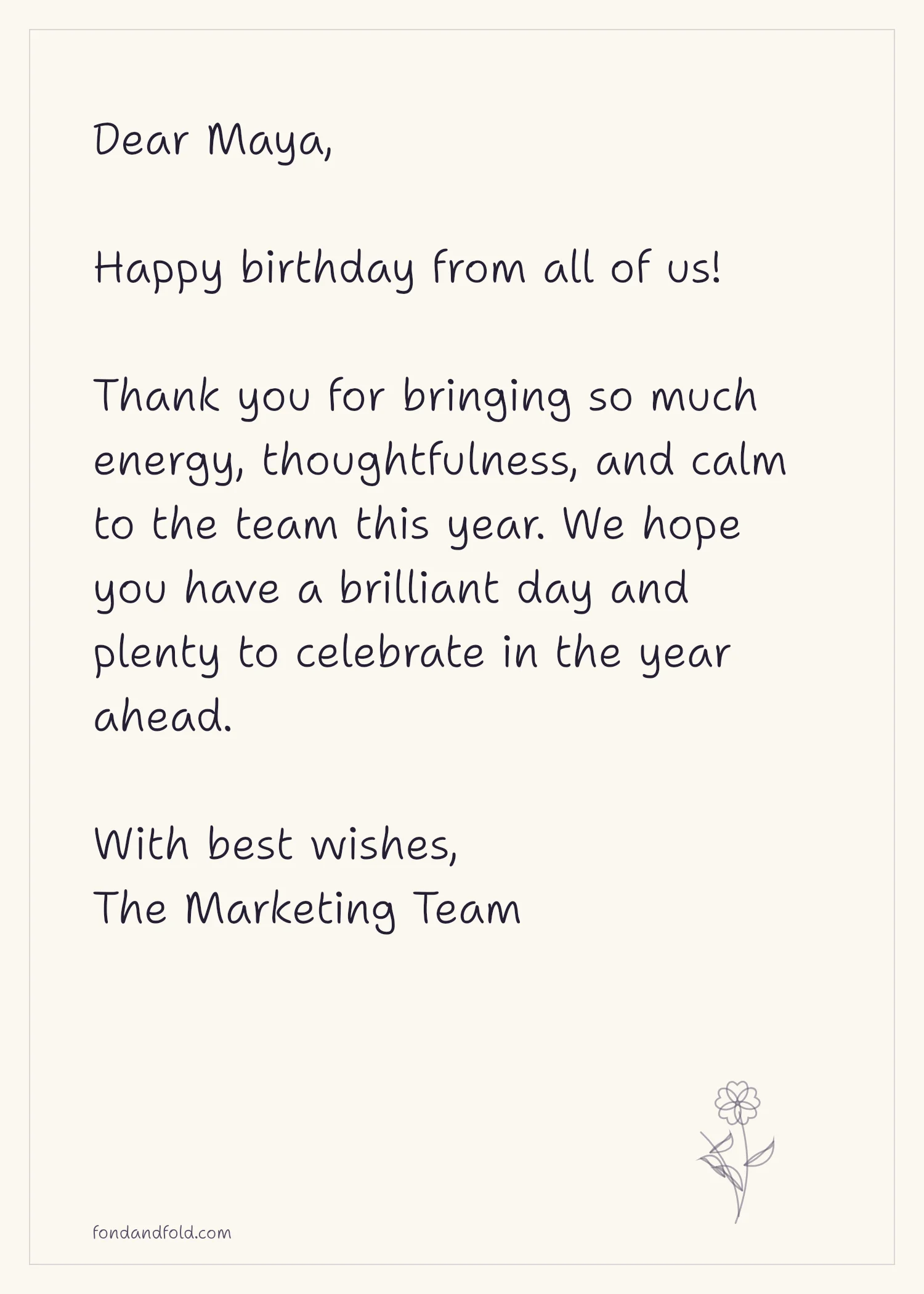

Neither version is more correct. The inside simply reflects who is speaking.
Choose a card that feels like the coworker
The message matters, but the design sets expectations before they read a word inside.
For a colleague you do not know especially well, Birthday Balloons & Confetti is the easiest all-rounder: bright, straightforward, and not tied to a very specific personality. For a more mature colleague, a mentor, or someone who likes quieter and more nostalgic design, Lavender Birthday Journal can feel more considered.
For a younger or particularly playful coworker, Paper Party Birthday brings much more energy, with layered cake, balloons, gifts, and confetti. It works best when that level of celebration feels like them.
For a coworker you know well who genuinely enjoys deadpan humor, Birthday on the Bench can make restraint itself the joke. One version reads:
One More for the Record
present for the birthday. staying for the cake.
That one needs a little more confidence in the recipient, because dry humor only reads as warm when both people know it is dry humor.
Rather than asking which card looks most professional, ask which one feels most like the person you are actually sending it to.





Put the birthday wish together
A good birthday message for a coworker does not need to sound corporate, and it does not need to pretend the two of you are close friends. Start with what the situation already gives you.
A quick toast can stay quick, and a group message can be public and warm. A personal card can say thank you, name something you genuinely admire, recall a shared year, or wish them well in something they care about. A team card can turn the same experience into a shared “we.”
At work, personal does not have to mean intimate. It can simply mean the words could not have been written to every other person in the company. A good coworker birthday wish says more than “someone at work has a birthday.” It says “I noticed who you are while we were working together.”
Fond & Fold’s cards are made for that kind of message. The designs and cover wording are chosen in advance, so you can pick a mood that suits the colleague, whether that is bright, quiet, or dryly funny, without designing a card between meetings. Their likeness becomes part of the illustration, and the inside leaves room for the work story, the private thank-you, or one shared message from the whole team.
We hope they open it and feel noticed for the work and for the person behind it, on a day that usually gets a quick message and a slice of cake.
The best workplace birthday messages stay professional without sounding interchangeable.