
Thank-You Card Messages for Coworkers That Feel Personal
Find words for the help, support, and everyday kindness you want to acknowledge.
Published

A coworker answers a question you have already asked once. Someone sends you the background to a meeting so you do not have to piece it together alone. Another person quietly makes sure your idea gets credited to you. These moments can pass without much attention because the workday keeps moving. A thank-you note gives you a moment to tell someone you noticed, whether they helped deliver something big or made an ordinary workday better.
Notice the everyday things worth thanking someone for
You do not have to wait for a successful launch, a completed campaign, or someone stepping in during a crisis. Think back to a recent workday. What made it easier, clearer, or more welcoming? Who helped you understand something? Who kept a small problem from becoming a bigger one? Who made room for you to contribute?
Look at how someone does their work as well as what they deliver. Preparing a handoff might be part of their job; making the notes clear enough for a newcomer to follow still takes care. Answering a question may be routine, but doing it patiently can make a difference to the person asking. Something does not have to fall outside a job description to deserve appreciation.
Notice the less visible contributions, too: checking that a remote colleague can hear the discussion, sharing useful context before a meeting, or explaining why a decision was made rather than simply passing it along. You might be grateful for the time you saved, the confidence you gained, or simply feeling included. Not every kindness needs a measurable business result.
For ongoing support, think of one moment that captures the pattern. Perhaps a colleague regularly checks in while you learn a new role, and last week they remembered to explain a process you had not encountered yet. That detail will say more than “You are always so helpful.” It is easy to get used to regular support and forget to mention how much you appreciate it.
Write a message that fits the help and the relationship
Start with what they did, the difference it made, and what you appreciate about it. You do not need to force every note into the same three sentences. Give your coworker enough detail to recognize the moment you mean.
Use these examples as starting points, replacing the details with something true to your experience.
Describe what they did and why it mattered
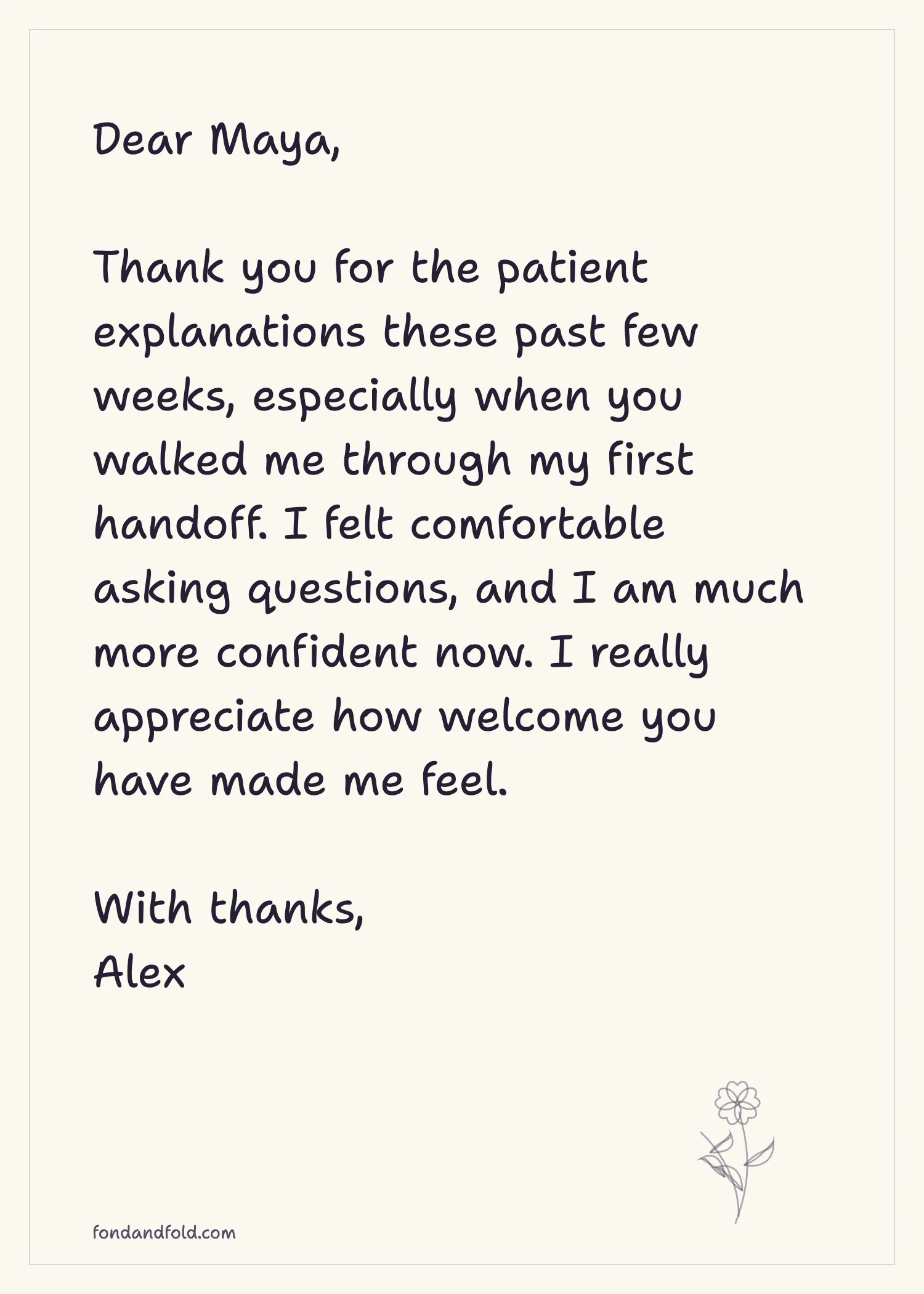
Instead of stopping at “Thanks for your help,” say which help you mean. For someone who patiently explained a task, you could write:
For a colleague who found something you needed:
Being less rushed or knowing where to begin is enough. Describe the difference it made to you without turning every helpful gesture into “You saved the whole project.”
Make ongoing appreciation specific, too
For support over time, name the pattern and give an example. You do not have to summarize everything they have ever done.
Or, for the small things that help someone feel included:
A late thank-you can use the same approach. Briefly acknowledge the delay, then return to their contribution: “I should have said this sooner: thank you for covering the first hour of my shift last month. Having that time made a difficult morning much easier.” Keep the focus on what you appreciated, not on a long apology.
Let the working relationship guide the tone
You can make a note personal without making it intimate. With a peer you do not know well, straightforward warmth is enough:
With a work friend, there may be room for familiar humor, as long as the thanks remain clear:
When thanking a manager or mentor, focus on a particular decision, explanation, or opportunity rather than making a sweeping statement about their leadership:
If you manage the person, acknowledge their judgment and care without turning the note into a performance review or adding another request:
For someone in another department, explain what their work made possible on your side:
With an external partner, stay grounded in your work together and avoid unfamiliar internal shorthand:
Use the name and closing that fit your usual correspondence. A simple “With thanks” works without making a professional relationship feel distant or overly affectionate.
Use a shared voice when the thanks come from a team
A team note should describe something the group can honestly appreciate. Keep a consistent “we” rather than switching between your own experience and everyone else's, and agree on the wording with the people you are representing.
For someone who has made everyday collaboration easier, a complete note could read:
Sign with a team name or the names of the people represented by the note.
Choose how to deliver your thanks
Think about how the person would like to receive your thanks and who else should hear about their contribution. A private message or card can carry the personal side of your thanks; a workplace recognition channel can bring their work to a wider audience. You can use both.
Say it directly while the moment is still fresh
A spoken thank-you, a short email, or a private chat message may be all you need. Use the same specific wording you would put in a card, without making every kindness into a formal event.
Let the thank-you stand on its own before asking for another favor. If the help involved something personal, thank them privately instead of explaining the circumstances to a wider audience.
Use internal shout-outs, nominations, and recognition votes
When your workplace has a shout-out channel, a peer-recognition form, or a way to nominate colleagues for an award, make use of it. Where a recognition program invites employee votes, take the time to participate when a colleague's contribution fits the criteria. Do not assume that the people responsible for recognizing their work already know what they did.
This can be especially useful when someone helps another department or does work that few people see. A specific acknowledgment can put that contribution in front of their manager and other colleagues who may never have seen it. Helping them get credit is another way to thank them.
Write for someone who was not there. Name the person, describe their contribution, and explain the difference it made. For example:
Match the acknowledgment to the channel: a brief shout-out may suit an everyday contribution, while an award nomination may call for examples of sustained work. Keep sensitive details out of anything shared widely, and choose an audience the person would be comfortable with. If there is no formal channel, a short note to their manager can be appropriate when you are sharing genuine feedback about work you experienced firsthand.
A public acknowledgment helps others see their contribution; a private thank-you tells them what it meant to you. You can do both.
Give a personal thank-you a card of its own
A card can be a good choice when you have been meaning to thank someone for patient guidance or a stretch of steady support. It gives your thanks a place of their own, away from the next work request, in something you have chosen for them. A handwritten card works well when you can give it in person; a digital card is another way to make the gesture personal.
Choose the mood as carefully as the message. A quiet botanical design may suit a colleague who prefers understated things, while a brighter illustration may suit someone more expressive. Let your relationship guide the warmth. More emotional wording does not necessarily sound more sincere.
For example, Fond & Fold’s Botanical Collage Thank You is a digital card that turns their photo into an illustrated portrait among flowers and paper-collage details. One existing cover pairs these words:
HEARTFELT THANKS
for all you do.
Then use the note inside to explain what “all you do” means in this relationship. For a coworker who has helped you settle into a role, an original example could read:
The cover words are selected from the options for that design; the personal note is your own. For a team thank-you, one person can make the card with a shared message and a team name as the sender. That is one note on everyone's behalf, rather than a card that collects separate online signatures.


A thoughtful thank-you starts with paying attention. Name the contribution, choose words that fit your relationship, and let the appreciation reach the person in a way they would welcome. When their work deserves wider recognition, help it reach the people who should know about it, too. You can show that you noticed an ordinary kindness without making it sound extraordinary.
Fond & Fold pairs carefully chosen designs and cover messages with room for your own words. You can choose a tone that feels right for this colleague without having to design a card from scratch. Their likeness becomes part of the illustration, while your note names the particular care or support that prompted you to send it.
Together, the picture and your words thank the person as well as acknowledge the work they have done. We hope opening the card feels like a moment of being appreciated for the patience, thought, and kindness they bring to working with you.
Everyday kindness is still worth putting into words.