How to Reach Out to an Old Friend: First Messages and What Comes Next
Choose an opening that fits why you lost touch, then think through a warm reply, a brief reply, or no reply at all.
Updated
Some friendships don’t end. They just slip out of everyday life. You graduate, move to different cities, change jobs, get married, raise children, or take on responsibilities that didn’t exist when you first met. At first you still trade the occasional message. Then the months between conversations turn into years.
The friendship doesn’t necessarily leave your memory, though. You might still remember the afternoons you spent together, the ridiculous jokes that once made you laugh, or how someone helped you through an important chapter of your life. Sometimes you wonder what they’re doing now and whether they’d enjoy hearing from you.
Reaching out can feel surprisingly awkward, even when nothing bad happened between you. You wonder whether the message will be welcome. On the other end, your old friend might be delighted, mildly curious, or unsure why you’re suddenly in touch. A thoughtful first message makes that uncertainty easier for both of you: it gives a little context, shows genuine interest, and leaves room for the conversation to develop on its own.
Know what you want from the hello
Before writing anything, think about what you’re hoping for. Perhaps you simply want to know your old friend is doing well. Maybe you’ve been remembering your time together and would enjoy sharing those memories. You might want to catch up properly, meet for coffee, or find out whether there’s still room for a friendship in your lives today.
All of these are reasonable, but they come with different expectations. If you only want to send a friendly greeting, there’s no need to turn it into a long conversation; a warm message that doesn’t ask for an update may be enough. If you’d genuinely like to reconnect, be ready to hear about their life as it is now, including the parts you weren’t around for. And if you’re really hoping to meet, consider whether that would be comfortable for both of you. Someone you haven’t spoken to in five years may want to reconnect through messages for a while before deciding whether to meet.
A simple check-in is a perfectly good reason to get in touch. You don’t need a major life event, an announcement, or a practical excuse to care about someone. What matters is that the message reflects the attention you’re genuinely willing to give.
Your reasons for reaching out may also differ from how your friend sees the relationship. You may remember an especially close friendship, while they remember a pleasant but more casual one. Neither view has to be wrong.
Find a natural reason to say hello
Often the hardest part is finding a first sentence that doesn’t seem to come out of nowhere. A natural opening gives you something familiar to talk about and helps the other person understand why they came to mind.
Start with something on social media
Social media keeps a light connection alive even when you haven’t spoken directly in years. If an old friend posts a photo of a familiar place, celebrates an accomplishment, or shares something you genuinely find interesting, a thoughtful comment is an easy way back in. After a photo from a hiking trip, you could write:
It’s a small gesture, but it gives your friend something specific to answer. If they reply with enthusiasm, the exchange may move into a private conversation. Not every comment needs to become a longer conversation, though; a friendly one can be enough to show you still think of them.
Use birthdays and holidays as an opening
Birthdays and holidays give you a reason to send a message even after a long silence, and a simple birthday greeting can stand on its own, whether you send it as a text or tuck it inside a card. Paper Party Birthday, for example, puts your friend’s name on the cover:
Happy Birthday to
Emily
Wishing you a wonderful day and year ahead!
The inside then only needs a line or two and a shared memory:

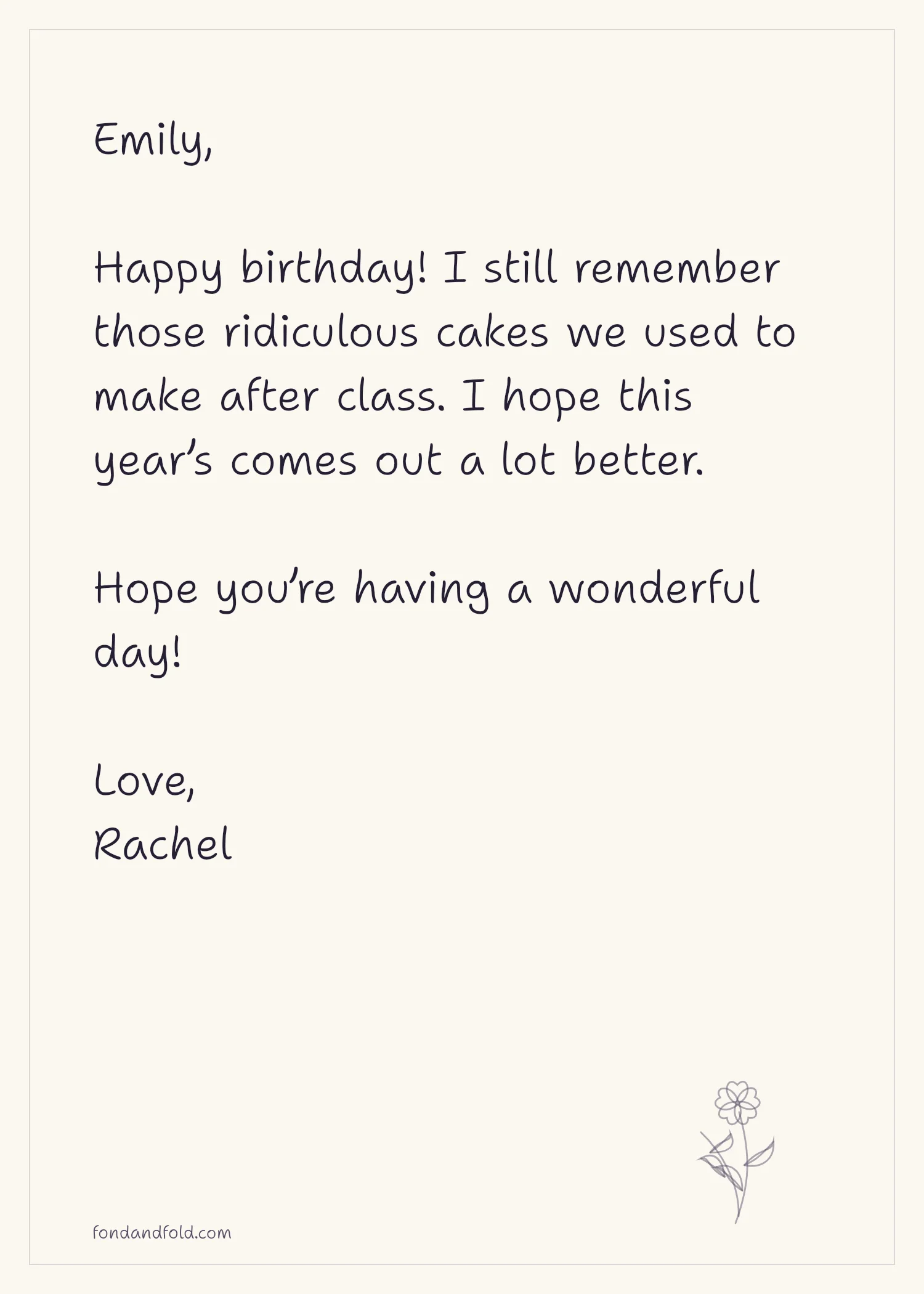

The shared memory makes the greeting personal, but Emily doesn’t have to do anything beyond saying thank you. If she wants to keep talking, she has an easy opening. The same works for Christmas, New Year’s, or other occasions you know your friend celebrates: you can send a warm wish without expecting a full account of everything since you last spoke.
Sometimes it happens the other way around, and an old friend’s birthday greeting is what reopens the conversation. If you’re the one replying, our guide to thanking someone for birthday wishes covers ways to keep that conversation going.
Let an ordinary memory bring you back together
You don’t have to wait for a celebration. Everyday life is full of reminders of people who used to be part of it: a restaurant you once visited together, an old photograph, a song from school, or someone you both knew. These moments make natural openings because they connect what you’re doing now with something you shared. For a friend you used to have lunch with, you might write:
The message explains why you thought of them today, and it invites a memory of their own without asking for a long conversation. A mutual acquaintance can give you a similar opening, as long as you’re comfortable saying what you talked about and don’t pass along someone else’s private news.
Or simply check in
Not every message needs a story behind it. When you had a friendly relationship and simply want to send goodwill, an ordinary greeting is often the most natural choice:
A casual check-in doesn’t commit either of you to rebuilding the friendship. It can be the start of a conversation, or just a pleasant moment of contact.
Do’s and don’ts of reaching out to an old friend
Most advice about reconnecting is about finding the courage to send a message. It also helps to imagine receiving one after a long silence. An old friend may be glad to hear from you and still wonder what prompted it and what you’re hoping they’ll do next. These comparisons can make your message more comfortable to receive:
| Don’t | Do |
|---|---|
| Make them responsible for the silence. Opening with “Why did you disappear?” can sound like an accusation, even if you meant it as a joke. | Acknowledge the time apart without blame. “It’s been ages! I was thinking about you today and wanted to say hello.” |
| Assume your life event needs their participation. Moving away or coming back to town doesn’t mean someone should rearrange their schedule to see you. | Offer a genuine invitation. Share what’s happening in your life and suggest meeting only if they’d enjoy it too. |
| Ask for updates you aren’t ready to hear. A friendly question feels hollow if you disappear as soon as someone gives a thoughtful answer. | Match your question to your interest. If you want to catch up, make time for a real exchange. If you just want to say hello, a warm wish is enough. |
| Assume the friendship is as close as it used to be. Years of separate experiences can change how people see a relationship. | Get to know the person they are today. Start with a comfortable conversation and let familiarity grow again. |
| Push for attention, explanations, or a meeting. Repeated messages can turn an unanswered invitation into an obligation. | Respect their pace. Leave them room to answer briefly, suggest something different, or not continue. |
These aren’t rigid rules. “Where have you been hiding?” can be a perfectly affectionate joke between two friends who still share that sense of humor. What matters is whether the familiarity you’re expressing is still shared. A good reconnection starts with interest in the other person, not with an assumption about how much attention they owe you.
What to say after they reply, or don’t
Sending the first message is only part of reconnecting. What happens next tells you much more about whether you both want to continue. The exchanges below are fictional, and they show how the same friendly intention can lead to very different conversations.
When they’re happy to hear from you
Imagine messaging an old friend after passing the café where you used to study together:
The conversation works because you respond to what Nina actually shared, taking an interest in her life now while offering a little of your own. If she keeps engaging, you might eventually suggest a call or a meeting. There’s no need to rush that into the first exchange.
When their reply is brief but polite
Not everyone has the time or the wish to catch up. Your friend might answer warmly without opening a longer conversation:
And the conversation can end there. A brief reply isn’t necessarily a rejection; your friend may be busy, distracted, or simply happy to trade greetings without reopening the friendship. You don’t need to follow every polite answer with another question. Sometimes the nicest thing is to appreciate the reply and let the exchange close naturally.
When they’re more enthusiastic than you expected
There’s another possibility that gets less attention: your old friend may be far more excited about reconnecting than you are. Perhaps you meant to send a simple check-in, and they suggest meeting right away:
You don’t have to agree to a reunion just because you started the conversation. At the same time, don’t offer an alternative you have no intention of following through on. If you only have time for a short exchange, it’s fine to say so, and when someone shares a big update, acknowledge it before you wrap up. Reconnecting works best when both people can decide how much time and energy to give.
When they don’t reply
Sometimes there’s no answer. You may never know whether the message went unnoticed, arrived at a hard moment, or reached someone who doesn’t want to reconnect; silence doesn’t tell you what the other person is thinking. Resist turning one unanswered message into a string of increasingly urgent check-ins. If you later have a genuinely new reason to get in touch, you can decide then whether another message makes sense. No follow-up schedule makes a reply more likely or more deserved.
An unanswered greeting can be disappointing, especially if the friendship meant a lot to you. You can still be glad you said something sincere. Reaching out gives the other person a chance to respond; it doesn’t create an obligation.
Let the friendship find its present shape
If the first conversation goes well, it’s natural to wonder whether you can become close again. You might find you still share a sense of humor and enjoy talking as much as you once did. You might also find your lives have changed so much that you’re more comfortable as occasional acquaintances. Either outcome is possible, and neither makes the original friendship less meaningful.
Let the relationship develop through ordinary exchanges rather than rushing to recreate the past. A few messages may lead to a longer call. If you live nearby and both enjoy catching up, you might suggest coffee or a walk:
The invitation is clear, and the other person can decline without having to explain. Think about the effort involved, too: meeting in person may mean travel, schedule changes, or time away from family and work, so suggest something that’s easy and enjoyable for both of you.
When a personal card makes sense
For many old friendships, an ordinary text is the most natural way to begin. It feels spontaneous, asks very little, and lets both people decide whether to continue. Sometimes, though, a shared memory feels important enough to give it something more lasting: an old photo from a particularly happy time, or a wish to show that someone outside your everyday life still matters to you.
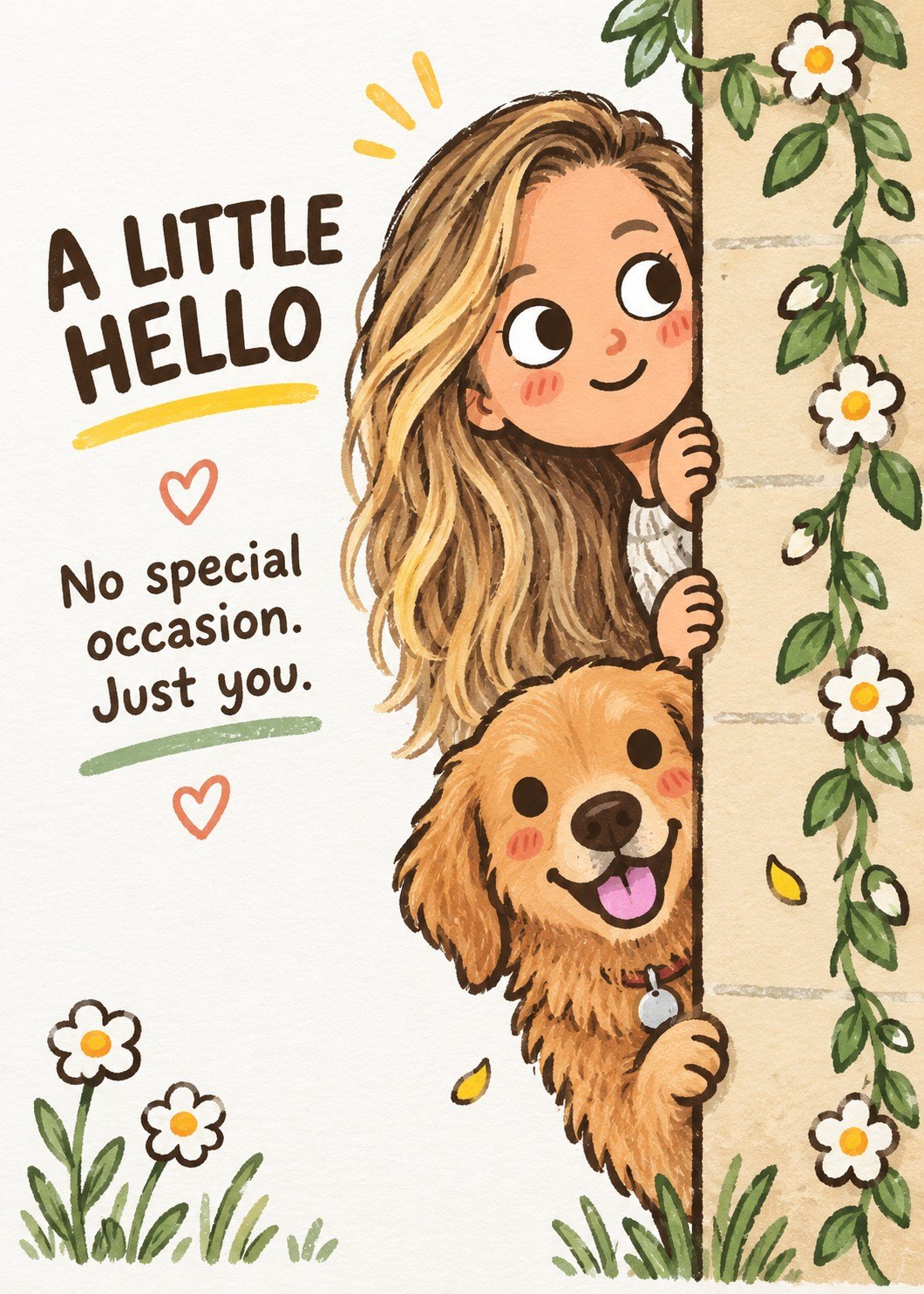
A personalized thinking-of-you card can give that memory a place of its own. Peekaboo Thinking of You is a lighthearted hello made from your own photo, with playful cover options such as “JUST CHECKING IN.” For a friend you were once especially close to, Stitched Memories for Two turns a photo of the two of you into a handmade-style collage, with a small tag that can read:
We’re overdue for coffee and a chat
The note inside can say what brought the friendship to mind. On this version, made for Ryan and Zoe, it reads:

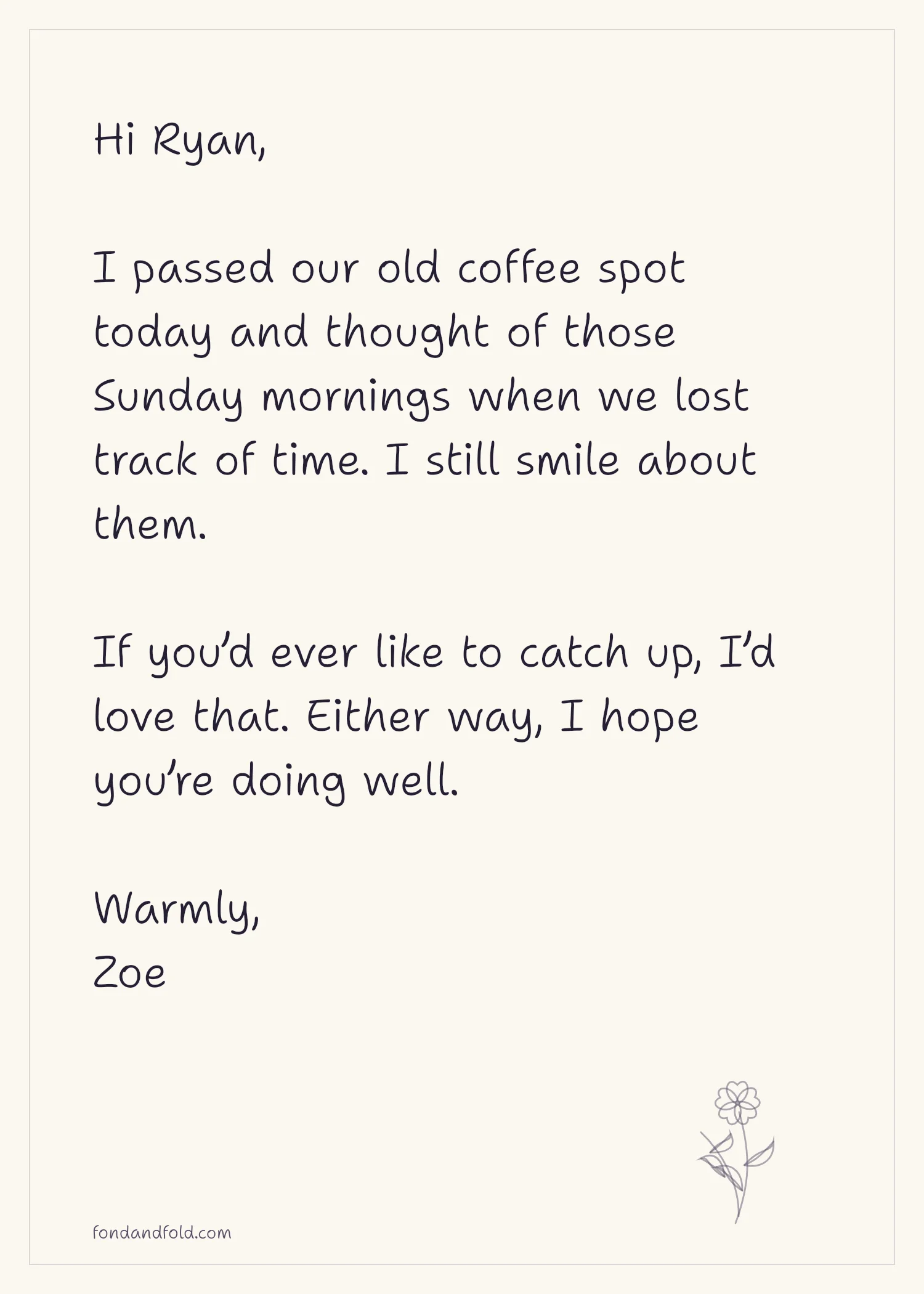

A card like this fits best when the memory and the gesture match the relationship you actually had. If you were casual acquaintances, or you’re unsure how they’d feel about something sentimental, a short text may be the kinder start. A card doesn’t guarantee a reply. It gives you another way to show why you thought of someone and what you remember about your time together.
Reconnecting with an old friend can bring someone back into your life, but it doesn’t have to end in a renewed friendship to be worthwhile. The first message is an invitation to see whether you still enjoy knowing each other. A thoughtful approach respects both the history you share and the separate lives you’ve built since. You can remember someone fondly without expecting them to feel exactly as they did years ago.
At Fond & Fold, we make cards for moments when a passing thought deserves a little more expression. The designs and cover wording are prepared in advance, so you can choose something that suits the relationship without creating the artwork yourself. A familiar face or shared photo becomes part of the illustration, and the note inside leaves room for the memory, observation, or simple greeting only you can write. It makes the hello more personal without making the next step more demanding.
We hope the person who receives your message recognizes something good about the time you once shared. Perhaps they’ll reply with a memory of their own, and you’ll find there’s still plenty to talk about. Perhaps you’ll trade a few kind words and go back to your separate lives. Either way, you’ve acknowledged a friendship that once mattered, and left both of you free to decide what it means today.
Reach out to the person they are now, not only the friend you remember.